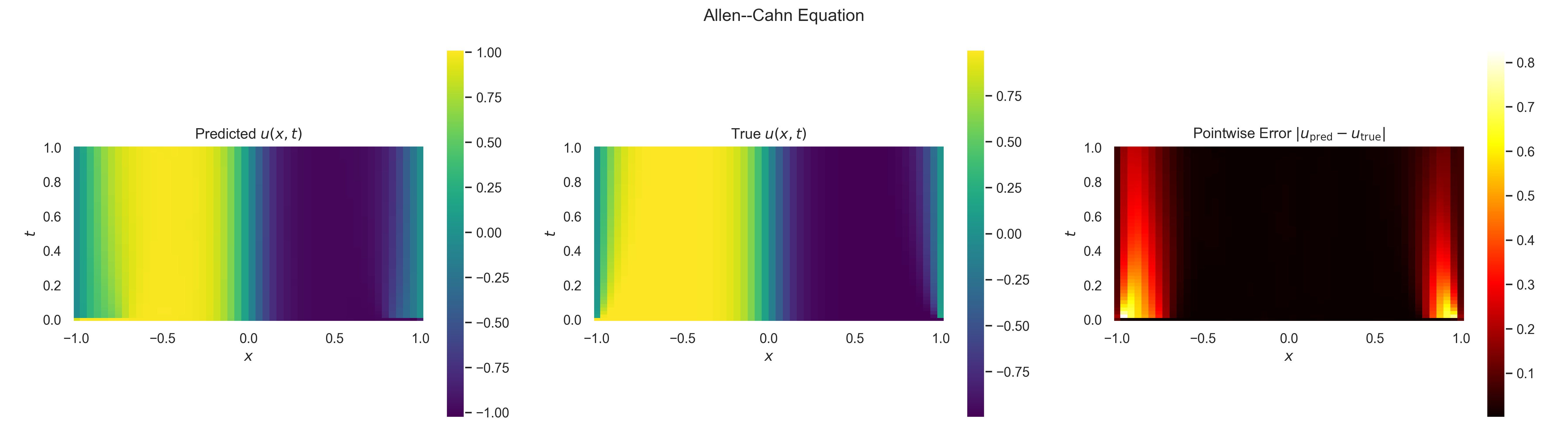
Allen-Cahn
Stiff reaction-diffusion PDE with sharp interfaces. Forward problem demonstrating adaptive sampling and periodic boundary conditions.
Background
The Allen-Cahn equation, introduced by Allen and Cahn (1979), models phase separation and interface motion in binary alloys and other materials. The solution \(u\) represents a non-conserved order parameter that evolves under a double-well potential (\(u - u^3\) term), driving it toward the two stable phases \(u \approx \pm 1\). The diffusion coefficient \(\varepsilon\) controls the interface width; small \(\varepsilon\) produces sharp transition layers between phases, creating stiff dynamics that challenge standard PDE solvers and require adaptive sampling to resolve accurately.
Governing Equations
where:
- \(u(x, t)\): order parameter (phase field)
- \(\varepsilon\): diffusion coefficient controlling interface width (known)
Default Configuration
The generated template uses the following values.
Known constants:
| Symbol | Code constant | Value |
|---|---|---|
| \(\varepsilon\) | TRUE_EPSILON |
\(0.01\) |
Initial condition: \(u(x, 0) = -\tanh\!\left(\dfrac{x}{\sqrt{2\varepsilon}}\right)\), the stationary kink profile centered at \(x = 0\).
Boundary conditions: periodic (\(u(-1, t) = u(1, t)\)).
Domain: \(x \in [-1, 1], \quad t \in [0, 1]\)
Features Demonstrated
AdaptiveSamplerfor resolving sharp interfaces- Periodic boundary conditions
- Stiff PDE dynamics (small \(\varepsilon\))
- Forward problem (no parameter recovery)
Results