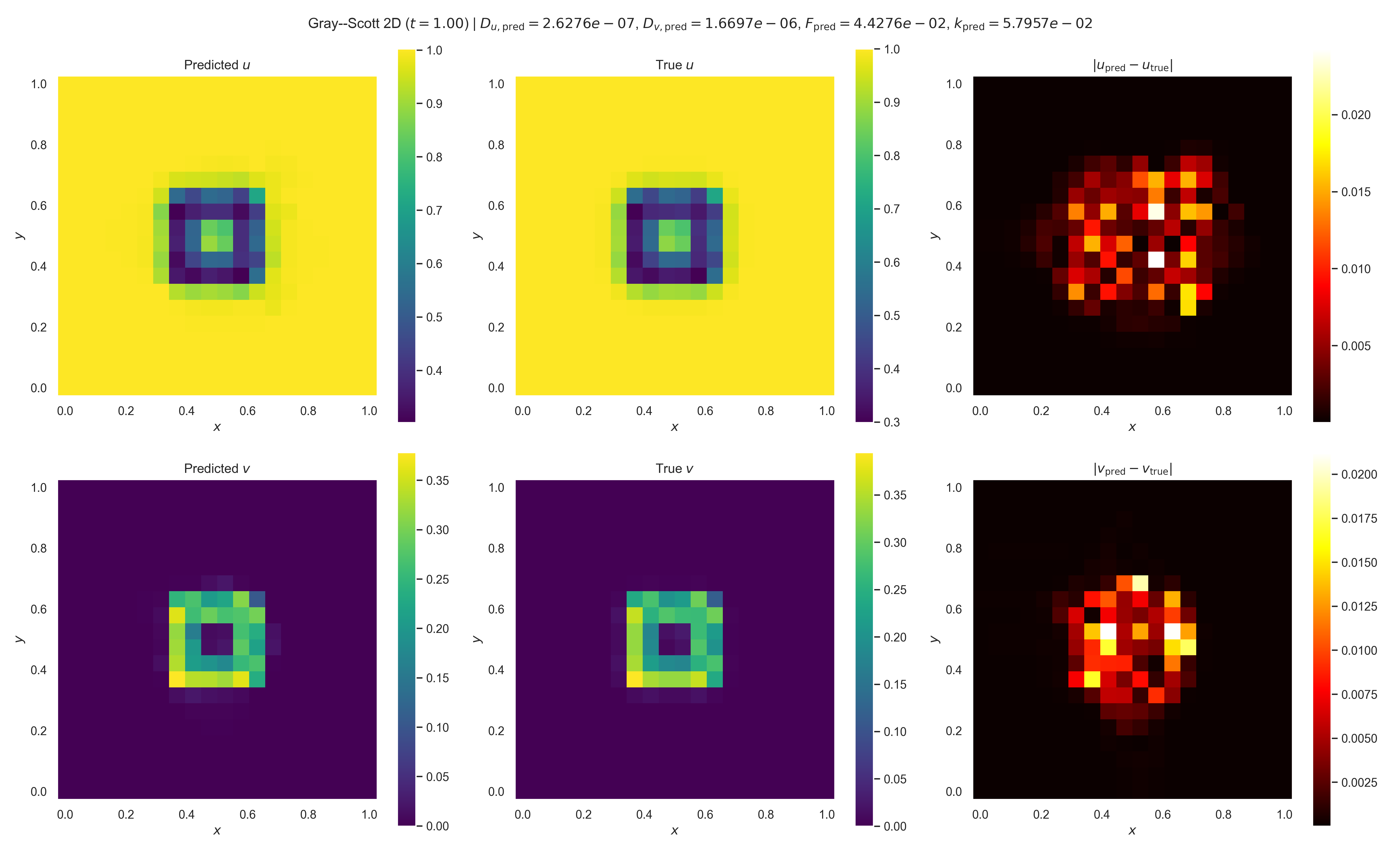
Gray-Scott 2D
Coupled two-field reaction-diffusion PDE. Recovers diffusion rates and reaction parameters from pattern snapshots.
Background
The Gray-Scott model describes two reacting and diffusing chemical species in a continuously stirred tank reactor: a substrate \(u\) is fed at rate \(F\) and consumed by an autocatalytic reaction \(u + 2v \to 3v\), while the product \(v\) decays at rate \(F + k\). Depending on the feed rate \(F\) and kill rate \(k\), the system produces a rich variety of Turing-type patterns including spots, stripes, labyrinthine structures, and self-replicating pulses. It is widely studied as a prototype for self-organizing pattern formation in chemistry and developmental biology.
Governing Equations
where:
- \(u(\mathbf{x}, t)\): substrate concentration
- \(v(\mathbf{x}, t)\): product concentration
- \(D_u, D_v\): diffusion coefficients (to recover)
- \(F\): feed rate (to recover)
- \(k\): kill rate (to recover)
- \(\nabla^2 = \dfrac{\partial^2}{\partial x^2} + \dfrac{\partial^2}{\partial y^2}\): 2D Laplacian
Default Configuration
The generated template uses the following values.
Parameters to recover:
| Symbol | Code constant | True value |
|---|---|---|
| \(D_u\) | TRUE_DU |
\(5 \times 10^{-3}\) |
| \(D_v\) | TRUE_DV |
\(2.5 \times 10^{-3}\) |
| \(F\) | TRUE_F |
\(0.04\) |
| \(k\) | TRUE_K |
\(0.06\) |
Initial conditions: \(u = 1,\; v = 0\) everywhere, except a central square \([0.4, 0.6]^2\) where \(u = 0.5,\; v = 0.25\) (seeding the pattern).
Domain: \((x, y) \in [0, 1]^2, \quad t \in [0, 200]\)
Boundary conditions: Neumann (zero-flux) on all edges.
Features Demonstrated
- 2D PDE with coupled fields
PDEResidualConstraintwith field-subset scoping- Multi-parameter recovery (diffusion rates and reaction parameters)
Results