Van der Pol Oscillator
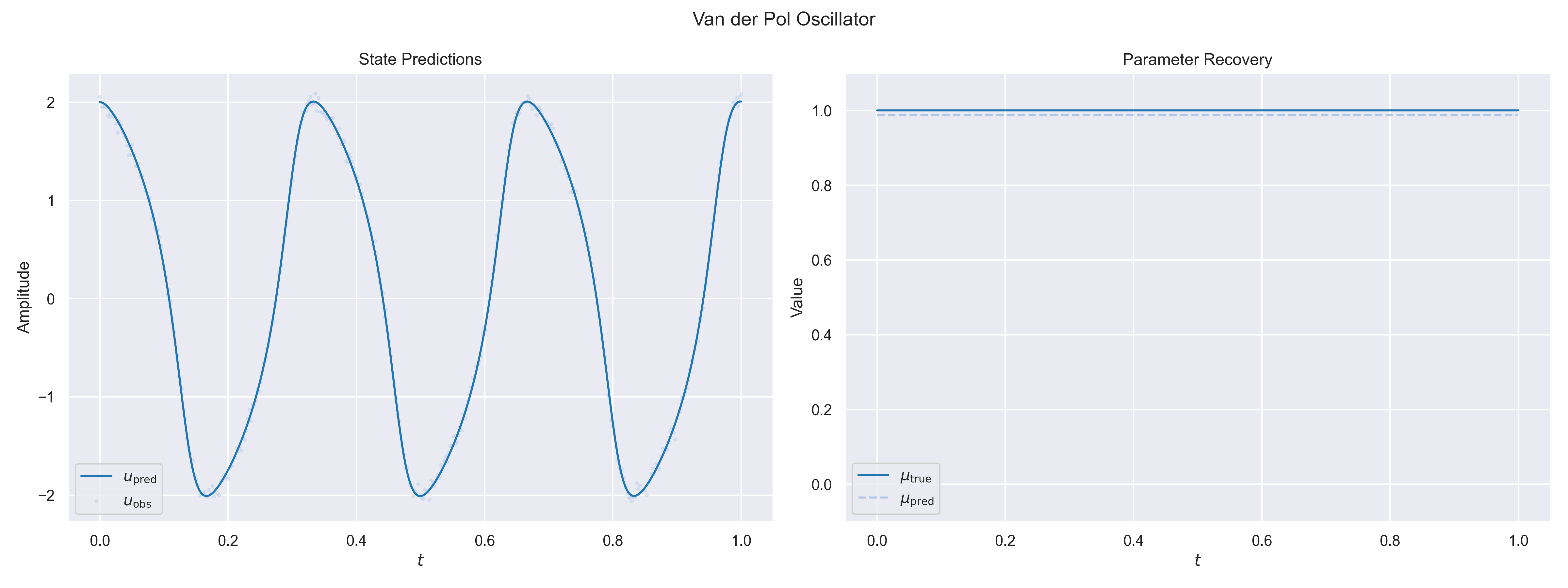
Second-order nonlinear oscillator. Recovers nonlinearity parameter \(\mu\).
Background
The Van der Pol oscillator, proposed by Balthasar van der Pol (1926) to model oscillations in vacuum tube circuits, is a canonical example of a self-excited oscillator. When \(\mu > 0\) the system has negative damping for small amplitudes (energy injection) and positive damping for large amplitudes (energy dissipation), producing a stable limit cycle, a self-sustaining periodic orbit whose shape and amplitude are independent of initial conditions. For small \(\mu\) the waveform is nearly sinusoidal; for large \(\mu\) it becomes a relaxation oscillation with alternating slow drifts and rapid jumps.
Governing Equations
Equivalently, with \(v = \dot{x}\):
where:
- \(x(t)\): displacement (state variable)
- \(v(t)\): velocity
- \(\mu\): nonlinearity / damping strength (to recover)
Default Configuration
The generated template uses the following values.
Parameters to recover:
| Symbol | Code constant | True value |
|---|---|---|
| \(\mu\) | TRUE_MU |
\(1.0\) |
Initial conditions: \(x(0) = 2.0, \quad \dot{x}(0) = 0.0\)
Domain: \(t \in [0, 20]\) s
Features Demonstrated
- Second-order ODE support via
ODEProperties.order - Nonlinear dynamics with limit cycles
- Scalar
Parameterrecovery
Results