Lorenz System
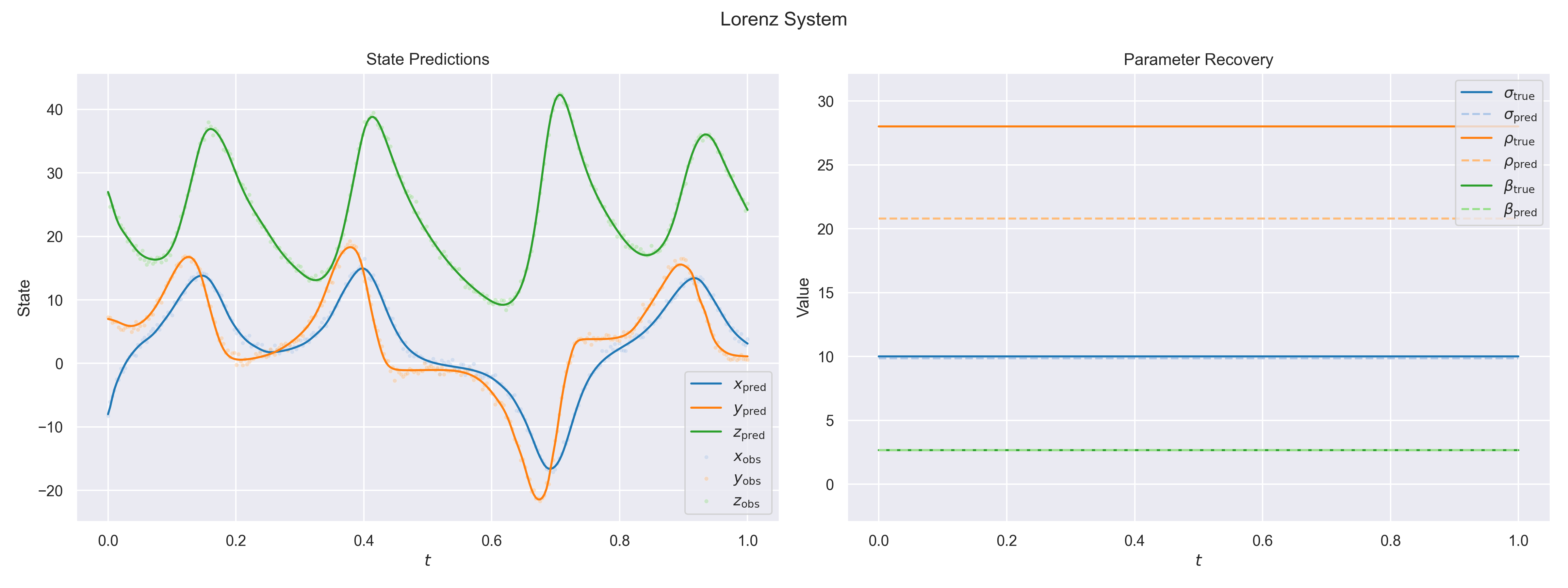
Chaotic 3-field ODE. Recovers \(\sigma\), \(\rho\), and \(\beta\) simultaneously from trajectory observations.
Background
The Lorenz system, derived by Edward Lorenz (1963) as a simplified model of atmospheric convection, is one of the earliest and most studied examples of deterministic chaos. For the classical parameter values (\(\sigma = 10\), \(\rho = 28\), \(\beta = 8/3\)) the system exhibits extreme sensitivity to initial conditions (the "butterfly effect"). Trajectories settle onto a fractal strange attractor that never repeats. Recovering all three parameters simultaneously from a noisy, chaotic trajectory tests the robustness of the inverse solver; Huber loss is used to mitigate the effect of outlier residuals.
Governing Equations
where:
- \(x(t)\): proportional to convective circulation intensity
- \(y(t)\): proportional to temperature difference between ascending and descending currents
- \(z(t)\): proportional to deviation from linear vertical temperature profile
- \(\sigma\): Prandtl number (to recover)
- \(\rho\): normalized Rayleigh number (to recover)
- \(\beta\): geometric factor (to recover)
Default Configuration
The generated template uses the following values.
Parameters to recover:
| Symbol | Code constant | True value |
|---|---|---|
| \(\sigma\) | TRUE_SIGMA |
\(10.0\) |
| \(\rho\) | TRUE_RHO |
\(28.0\) |
| \(\beta\) | TRUE_BETA |
\(8/3 \approx 2.667\) |
Initial conditions: \(x(0) = -8, \quad y(0) = 7, \quad z(0) = 27\)
Domain: \(t \in [0, 3]\)
Scaling: state variables are divided by \(S = 20\) in the training ODE.
Features Demonstrated
- Multi-parameter recovery (3 simultaneous parameters)
- Huber loss via
PINNHyperparameters.criterionfor robustness to chaotic trajectories - 3-field system
Results