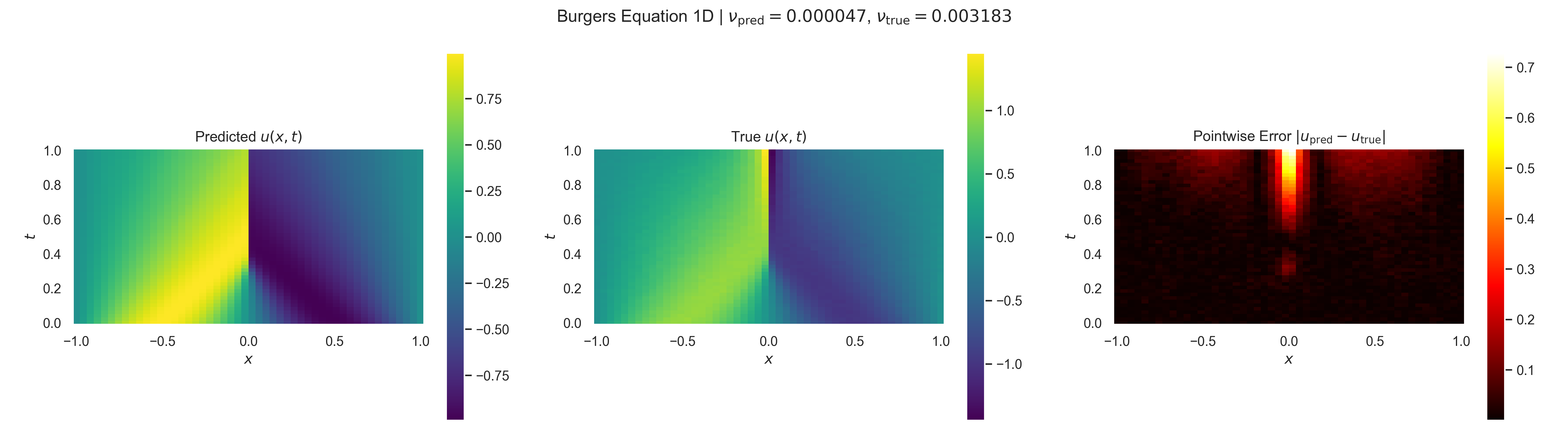
Burgers Equation 1D
1D nonlinear PDE with shock formation. Recovers viscosity \(\nu\) with adaptive collocation.
Background
The viscous Burgers equation combines nonlinear advection (\(u\,\partial u / \partial x\)) with diffusion (\(\nu\,\partial^2 u / \partial x^2\)). It serves as a one-dimensional prototype for the Navier-Stokes equations and is a standard benchmark for methods that must handle shock formation. As the viscosity \(\nu \to 0\) the solution develops steep gradients that evolve into shock-like fronts, concentrating the PDE residual in narrow regions. This motivates the use of adaptive collocation, which places more training points where the residual is largest.
Governing Equations
where:
- \(u(x, t)\): velocity field
- \(\nu\): kinematic viscosity (to recover)
Default Configuration
The generated template uses the following values.
Parameters to recover:
| Symbol | Code constant | True value |
|---|---|---|
| \(\nu\) | TRUE_NU |
\(0.01 / \pi \approx 0.00318\) |
Initial condition: \(u(x, 0) = -\sin(\pi x)\)
Boundary conditions: \(u(-1, t) = u(1, t) = 0\) (homogeneous Dirichlet).
Domain: \(x \in [-1, 1], \quad t \in [0, 1]\)
Features Demonstrated
- Adaptive collocation via
AdaptiveCollocationCallback - Shock-forming nonlinear PDE
- Scalar parameter recovery (viscosity)
Results