FitzHugh-Nagumo
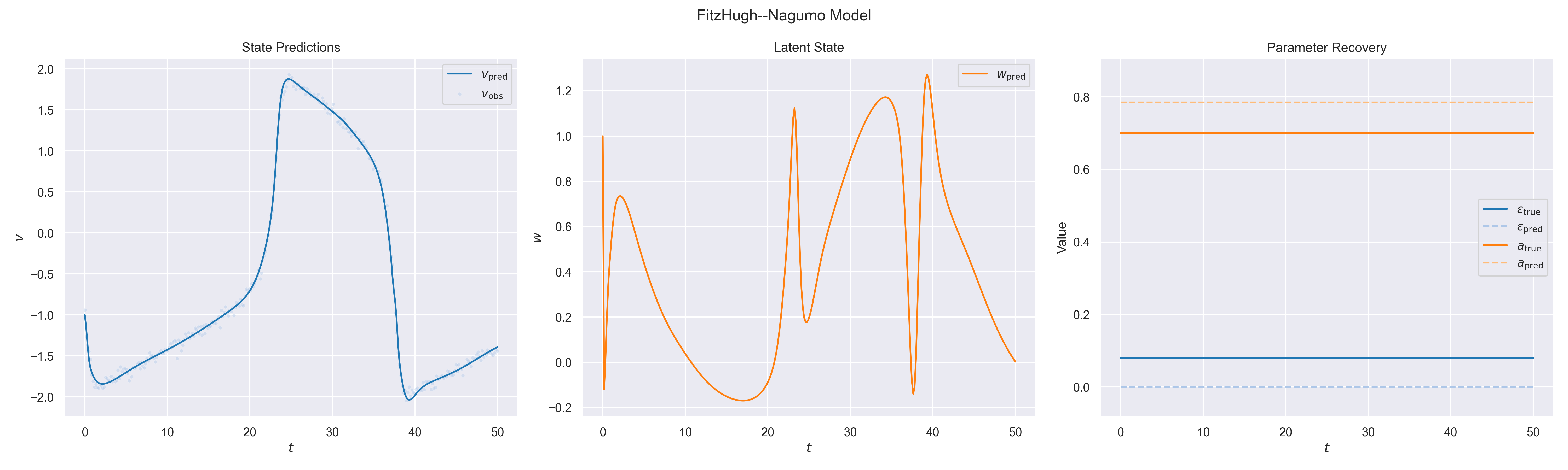
Two-field nonlinear neuron model. Recovers timescale \(\varepsilon\) and threshold parameter \(a\) from a partially observed voltage trace.
Background
The FitzHugh-Nagumo model, simplified by FitzHugh (1961) and Nagumo et al. (1962) from the four-variable Hodgkin-Huxley equations, captures the essential dynamics of neural spike generation with just two variables: a fast voltage-like variable \(v\) and a slow recovery variable \(w\). The model exhibits excitable dynamics: small perturbations decay, but a sufficiently large stimulus drives the system through a full action potential (spike) before returning to rest. The timescale separation parameter \(\varepsilon \ll 1\) governs how fast the recovery variable \(w\) responds relative to the voltage \(v\).
Governing Equations
where:
- \(v(t)\): membrane voltage (fast variable, observed)
- \(w(t)\): recovery current (slow variable, latent)
- \(\varepsilon\): timescale separation (to recover)
- \(a\): excitability threshold (to recover)
- \(b\): recovery sensitivity (known)
- \(I_{\text{ext}}\): external stimulus current (known)
Default Configuration
The generated template uses the following values.
Parameters to recover:
| Symbol | Code constant | True value |
|---|---|---|
| \(\varepsilon\) | TRUE_EPSILON |
\(0.08\) |
| \(a\) | TRUE_A |
\(0.7\) |
Known constants:
| Symbol | Code constant | Value |
|---|---|---|
| \(b\) | B |
\(0.8\) |
| \(I_{\text{ext}}\) | I_EXT |
\(0.5\) |
Initial conditions: \(v(0) = -1.0, \quad w(0) = 1.0\)
Domain: \(t \in [0, 50]\)
Observability: only \(v\) (voltage) is observed; \(w\) is a latent state reconstructed by the network.
Features Demonstrated
- Partial observability (only voltage is observed)
- Multi-parameter
Parameterrecovery (\(\varepsilon\) and \(a\)) - Neural excitation dynamics
Results