Lotka-Volterra
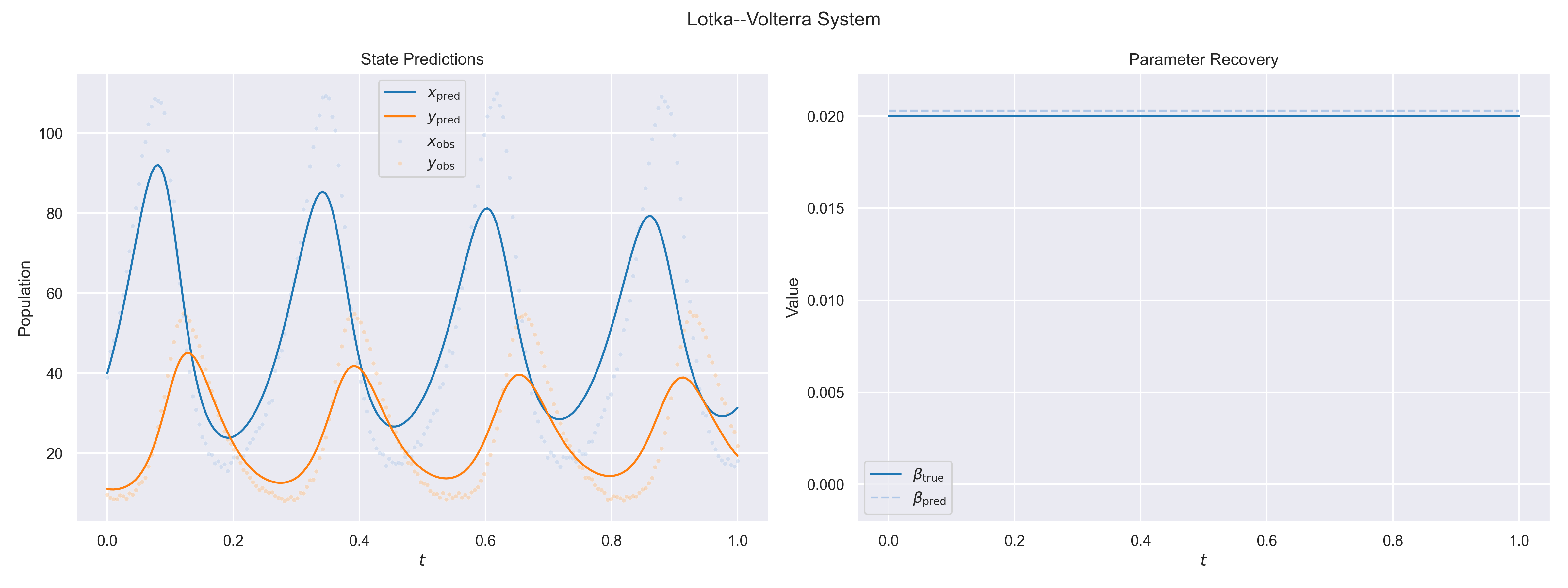
Predator-prey dynamics. Recovers predation rate \(\beta\) from population observations.
Background
The Lotka-Volterra equations, formulated independently by Alfred Lotka (1925) and Vito Volterra (1926), are the classical model of predator-prey interaction in ecology. The system exhibits characteristic oscillatory cycles: prey abundance fuels predator growth, which in turn suppresses prey, leading to predator decline and eventual prey recovery. The four rate constants (\(\alpha, \beta, \delta, \gamma\)) control the amplitude and period of these cycles. The model is a cornerstone of mathematical biology and population dynamics.
Governing Equations
where:
- \(x(t)\): prey population
- \(y(t)\): predator population
- \(\alpha\): prey birth rate (known)
- \(\beta\): predation rate (to recover)
- \(\delta\): predator growth rate per prey consumed (known)
- \(\gamma\): predator death rate (known)
Default Configuration
The generated template uses the following values.
Parameters to recover:
| Symbol | Code constant | True value |
|---|---|---|
| \(\beta\) | TRUE_BETA |
\(0.02\) |
Known constants:
| Symbol | Code constant | Value |
|---|---|---|
| \(\alpha\) | TRUE_ALPHA |
\(0.5\) |
| \(\delta\) | TRUE_DELTA |
\(0.01\) |
| \(\gamma\) | TRUE_GAMMA |
\(0.5\) |
Initial conditions: \(x(0) = 40, \quad y(0) = 9\)
Domain: \(t \in [0, 50]\)
Scaling: populations are divided by \(P = 100\) in the training ODE.
Features Demonstrated
FourierEncodingfor capturing oscillatory solutions- Scalar
Parameterrecovery ValidationRegistryfor ground-truth comparison
Results