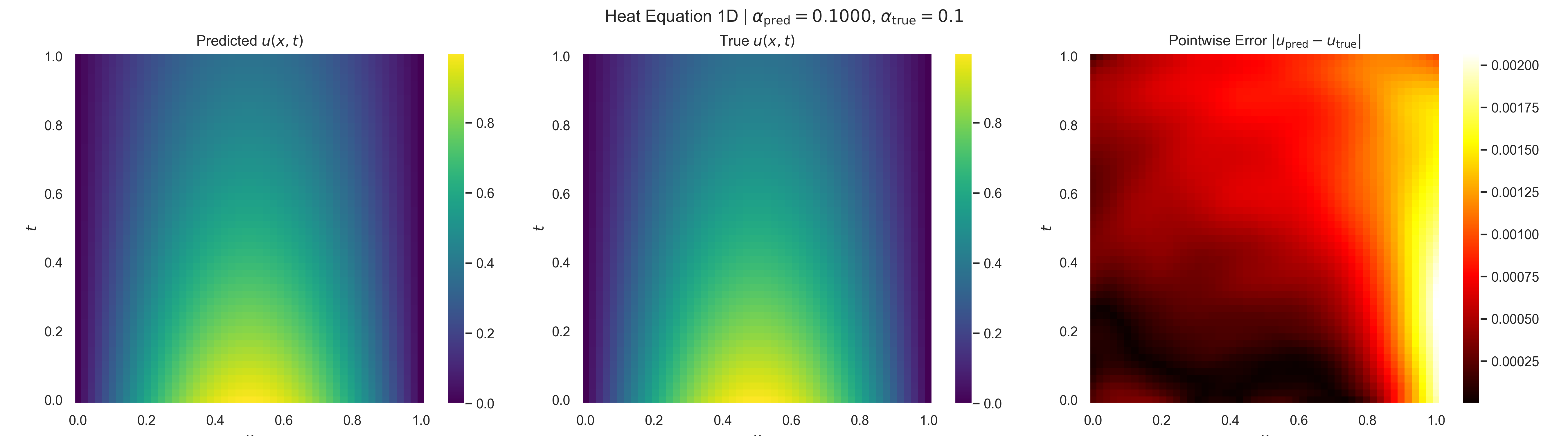
Heat Equation 1D
1D parabolic PDE inverse problem. Recovers thermal diffusivity \(\alpha\) from sparse temperature measurements.
Background
The heat equation describes thermal diffusion in a conducting medium according to Fourier's law. It is the prototypical parabolic PDE: an initial temperature profile smooths over time at a rate controlled by the thermal diffusivity \(\alpha\). The template uses a separable exact solution (exponential decay times a spatial mode) so that the recovered \(\alpha\) can be verified against the known analytical value. This makes it an ideal first example for PDE-based inverse problems.
Governing Equations
where:
- \(u(x, t)\): temperature field
- \(\alpha\): thermal diffusivity (to recover)
Exact solution used for data generation:
Default Configuration
The generated template uses the following values.
Parameters to recover:
| Symbol | Code constant | True value |
|---|---|---|
| \(\alpha\) | TRUE_ALPHA |
\(0.1\) |
Initial condition: \(u(x, 0) = \sin(\pi x)\)
Boundary conditions: \(u(0, t) = u(1, t) = 0\) (homogeneous Dirichlet).
Domain: \(x \in [0, 1], \quad t \in [0, 1]\)
Features Demonstrated
- PDE inverse problem (scalar parameter recovery)
- Sparse observation data
- Parabolic PDE handling
Results